
From Technical Expert to Influential Leader: Building Stakeholder Skills at Summer School

Technical expertise can take you a long way in the power sector. But as professionals progress through their careers, knowing the right technical answer is increasingly only part of the job.
Can you explain that answer to a board, regulator or community? Can you gain support from people with competing priorities? Can you navigate disagreement without losing sight of the project objective?
These are increasingly important capabilities for the people who will lead Australia's power sector through a period of unprecedented transformation.
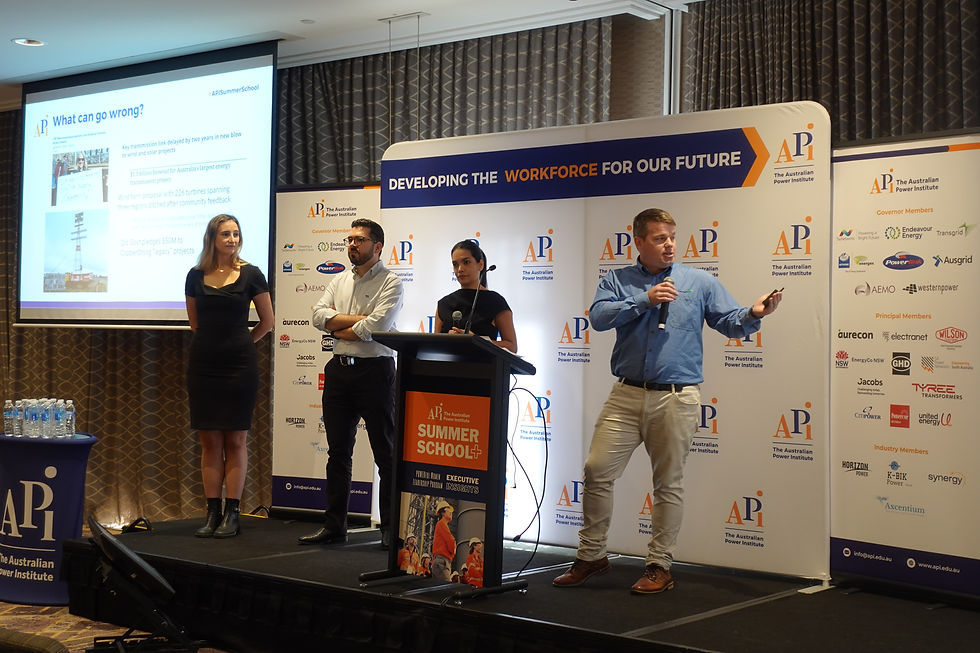
At the 2026 API Summer School, participants had the opportunity to explore these challenges through a dedicated Stakeholder Engagement workshop, delivered by Engineering Education Australia and designed specifically for professionals working across the power and renewable energy sectors.
Why stakeholder engagement matters
Power sector projects rarely have a single stakeholder or a simple set of objectives. A major project may need to navigate relationships with government, regulators, investors, customers, communities, landholders, contractors, internal teams and other industry organisations. Each can bring different interests, levels of influence and expectations. Effective stakeholder engagement therefore goes well beyond keeping people informed.
The Summer School workshop explored how participants can identify and map stakeholders, understand their interests and potential areas of conflict, and build relationships that support cooperation and influence. Participants were also introduced to techniques for negotiation and conflict resolution, stakeholder communication and advocacy, and communicating complex engineering information to non-technical audiences. Importantly, these skills were considered through the lens of the power and renewable energy sectors, where environmental regulation, community concerns, investor expectations and competing project priorities can all influence whether a project progresses successfully.
When technical expertise meets leadership
For engineers and other technical professionals, progressing into leadership often brings a significant shift. Success is no longer determined only by the quality of your own work. Increasingly, it depends on your ability to bring other people with you.
A technically sound recommendation may need the support of executives before funding is approved. A project solution may need to satisfy regulators while responding to community concerns. An engineering team may need to negotiate with other parts of the business whose priorities are very different from its own. This is why stakeholder engagement is fundamentally a leadership capability.

The workshop focused on building positive relationships and mechanisms for cooperation and influence, as well as using expertise to gain high-level support for initiatives. It also considered how stakeholder relationships can create or mitigate project risk. For emerging leaders, this provides an important shift in perspective: stakeholder engagement is not something that sits around the edges of project delivery. Done well, it can be integral to achieving the outcome.
Communicating complexity without losing the message
One particularly relevant capability for power sector professionals is communicating technical information to people who do not share the same technical background. Australia's electricity system is extraordinarily complex. Yet many of the people who influence its future, from government officials and investors to customers and communities, are not engineers. Being able to translate technical expertise into information that is clear, relevant and useful to the audience is therefore critical. It does not mean removing complexity from the decision. It means understanding what different stakeholders need to know and communicating your expertise in a way that enables informed decisions.
For professionals preparing to step into senior roles, this capability becomes increasingly valuable as their audience expands from immediate technical colleagues to executives, boards and external stakeholders.

Developing professionals who can lead across the sector
This workshop provides another example of the broader development experience offered through API Summer School. Across the program, participants are encouraged to step outside the boundaries of their immediate role. Alongside understanding the technical, market and strategic transformation of the power system, they develop capabilities that help them operate effectively within that complexity.
For young and emerging professionals, it is an opportunity to develop skills they may increasingly need as their responsibilities grow.
For organisations, it is an investment in professionals who can do more than provide technical expertise. They can communicate it, advocate for it, negotiate around it and build the relationships required to turn good ideas into successful outcomes. Because the future of the power sector will not only require people who understand complex problems. It will require leaders who can bring people together to solve them.


Comments