
Series 1: What Is the Power Industry?

Updated: Sep 18
I've spent 15+ years working across universities, research institutions, grant programs, and education technology - mostly in AI, emerging tech, data science and space. I know how to navigate a scholarship application, a research funding cycle, a PhD supervision relationship. I can hold my own in a conversation about AI talent pipelines or building a research program from scratch.
What I apparently cannot do is explain where my electricity comes from.
I've recently joined the Australian Power Institute as Scholarships and Student Programs Manager. The scholarships and student programs part? That I know. But the power industry part - the actual electricity sector - turned out to be a world I had no map for. From coal-fired stations to rooftop solar, how electricity is generated, moved, traded, monitored, delivered and governed across the country: I had no real picture of it.
So I'm doing what I'd do with any knowledge gap - I'm going to learn it properly and write it down. This is the first in a series taking you through everything I'm discovering about Australia's electricity industry. If you're a power industry professional reading this thinking "how does she not know this?" - that's exactly the point. Bringing people like me up to speed is API's whole mission.
Let's start with the thing that surprised me most in week one.
Australia doesn't have one electricity market. It has three.
I assumed there was a single national grid. There isn't. Australia operates three completely separate electricity systems - and they don't physically connect to each other.
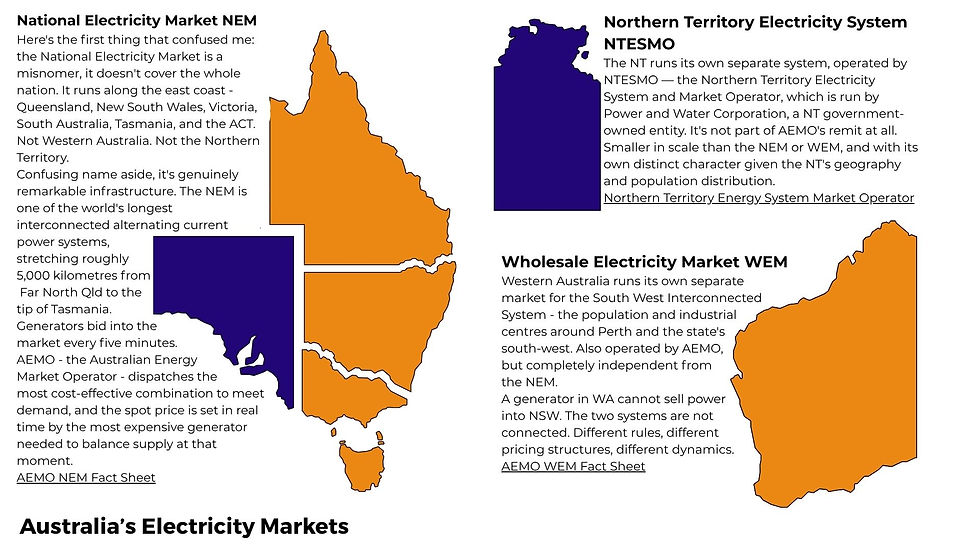
Three markets. Three physical grids. Two operators - AEMO running the NEM and WEM, and NTESMO (via Power and Water Corporation) running the NT system - each under their own regulatory frameworks.
This reframed a lot for me. When we talk about "the national grid" we're usually talking about one of three systems, and even that one isn't truly national. Policy decisions affect each system differently. The energy transition looks different depending on which grid you're in. And the organisations I'm now learning about through API - transmission companies like TransGrid in NSW, Powerlink in QLD, TasNetworks in TAS, and distribution businesses like Ausgrid and Energy Queensland - each operate within one defined piece of this picture. Their territory isn't "Australia." It's a specific slice of one of these three grids.
What's coming in this series
This post was always going to be the starting point - the "I don't know what I don't know" moment, put down in writing. From here, I'll go deeper into each part of how Australia's electricity industry actually works:
What is the Power Industry? - you're reading it
How Electricity is Made in Australia - generation, the fuel mix, and how it varies dramatically by state
The Grid: How Power Moves - transmission, distribution, and the physical infrastructure between a generator and your power point
The Market: AEMO, Spot Prices and Your Bill - how wholesale pricing translates into your quarterly bill
How Rooftop Solar, Batteries & EVs Are Reshaping the Grid - what it means when Australian households become both generators and consumers
Australia's Role in the Global Energy Economy - from coal and LNG exports to critical minerals, green hydrogen, and what our energy story looks like from outside
I'll flag when something needs verification or when my understanding is still developing - I'm learning as I write. If you work in the industry and I've got something wrong, please call it out. That's the fastest way I'll actually understand this properly.
I'm also looking for collaborators on these topics, if you're an expert in any of these sections let me know and we can work on one of the blogs together!


Comments